
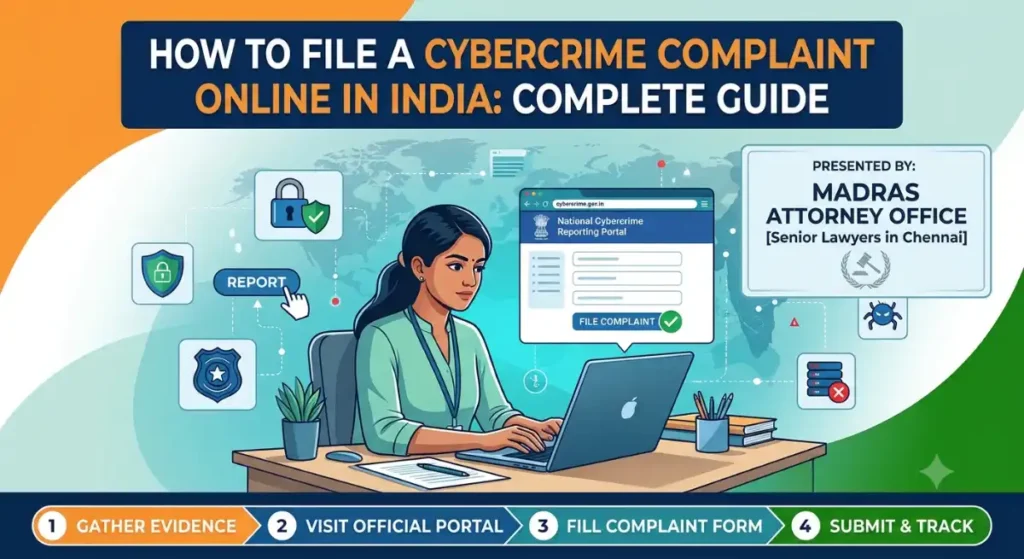
Yes — cybercrime in India can be reported through the National Cyber Crime Reporting Portal (cybercrime.gov.in) or by calling the dedicated helpline number 1930, and a complaint can be filed at any cyber cell in the country regardless of where the crime occurred, because cybercrime under the Information Technology Act, 2000 is treated as having nationwide jurisdiction. This guide walks through exactly what to do, in what order, and what evidence to preserve.
How to File an Online Cybercrime Complaint in India: A Complete Walkthrough
Step 1: Call 1930 Immediately for Financial Fraud
If money has been fraudulently taken from your bank account, UPI, card, wallet, or payment app, call the 1930 helpline immediately — speed genuinely matters here, because banks and payment systems can sometimes freeze or reverse a fraudulent transaction if flagged quickly. Before calling, have ready:
- The bank, UPI app, wallet, or merchant name involved.
- The transaction ID or UTR number.
- Date and time of the transaction.
- Amount lost.
- The phone number, email, website, app, or profile used by the fraudster.
- Your mobile number linked to the affected account.
Step 2: File a Detailed Complaint on the National Cyber Crime Reporting Portal
After calling 1930 (or independently, for non-financial cybercrimes), file a complaint on cybercrime.gov.in:
- Visit cybercrime.gov.in and select “Report Other Cyber Crimes” (for most complaints) or the specific reporting category if the matter involves crimes against women/children.
- Register using your mobile number and verify via OTP.
- Select the category and sub-category of the complaint from the dropdown menus.
- Enter the date, time, and location of the incident.
- Provide a clear, factual account of what happened, and upload supporting evidence (screenshots, transaction records, messages).
- Enter suspect details, if known.
- Submit complainant details and preview the complaint before final submission.
- On submission, you will receive an acknowledgement number — save this to track your complaint’s status later.
What Can Be Reported on the Portal?
The portal accepts complaints across a wide range of categories, including:
- Online financial fraud (UPI, card, net banking, investment scams).
- Hacking and unauthorised access to accounts or devices.
- Identity theft and impersonation.
- Social media crimes, fake profiles, and cyberstalking/harassment.
- Cyberbullying and online blackmail/extortion.
- Child sexual abuse material and content involving sexually explicit material of women (reportable through a dedicated section).
- Ransomware and malware attacks.
Legal Framework: IT Act and BNS Provisions
Cybercrimes in India are prosecuted mainly under two statutes — the Information Technology Act, 2000 and the Bharatiya Nyaya Sanhita, 2023 (BNS), which replaced the Indian Penal Code from 1 July 2024.
- Section 43, IT Act: Covers unauthorised access to computer systems and data, with civil liability for damages.
- Section 66, IT Act: Penalises computer-related offences (hacking), with imprisonment up to three years or a fine up to ₹5 lakh, or both.
- Section 66C, IT Act: Identity theft — fraudulent use of another person’s electronic signature, password, or unique identifying feature.
- Section 66D, IT Act: Cheating by personation using a computer resource or communication device, punishable with imprisonment up to three years and a fine up to ₹1 lakh.
- Section 66F, IT Act: Cyber terrorism.
- Section 318, BNS (corresponding to the earlier Section 420 IPC): Cheating and dishonestly inducing delivery of property — commonly invoked alongside IT Act provisions in online financial fraud cases.
Alternative Reporting Routes
- Local Cyber Cell: Most states have dedicated cyber crime cells; you can visit in person and file a written complaint if you prefer, or if online access is difficult.
- Local Police Station: Where no dedicated cyber cell is easily accessible, an FIR can be lodged at the jurisdictional police station.
- Your Bank: For financial fraud, notify your bank’s fraud/dispute team directly and promptly, in parallel with the 1930/portal complaint, since banks have their own internal timelines for disputing unauthorised transactions.
Statutory Framework at a Glance
| Provision | Covers |
|---|---|
| Section 43, IT Act | Unauthorised access; civil liability |
| Section 66, IT Act | Hacking / computer-related offences |
| Section 66C, IT Act | Identity theft |
| Section 66D, IT Act | Cheating by personation |
| Section 66F, IT Act | Cyber terrorism |
| Section 318, BNS | Cheating and dishonest inducement to deliver property |
Practical Checklist Before and While Filing
- Save screenshots of the fraudulent message, website, profile, or transaction before it can be deleted or taken down.
- Note transaction IDs, UTR numbers, timestamps, and any phone numbers or email addresses used by the perpetrator.
- Do not delete the original messages/emails even after screenshotting — the original metadata can matter for investigation.
- File the complaint as soon as possible — delay reduces the chances of fund recovery in financial fraud cases.
- Retain your complaint acknowledgement number and periodically check the status on the portal.
Exceptions and Cautions
- Filing a complaint does not guarantee recovery of lost funds; recovery, particularly in cross-border fraud, can be difficult and time-consuming.
- Complaints involving child sexual abuse material must be reported through the dedicated category on the portal, which routes to specialised units — do not describe or forward such material to others outside official reporting channels.
- This article provides general procedural guidance; the applicable provisions and outcome depend on the specific facts of each case.
What Should You Do Next?
If you have just discovered financial fraud, call 1930 first, then file the detailed complaint on cybercrime.gov.in without delay. For complex matters — significant financial loss, harassment, or where the platform/bank is unresponsive — consulting an advocate experienced in cyber law can help you pursue both the criminal complaint and any civil recovery options in parallel.
Frequently Asked Questions
Where do I report cybercrime in India?
Primarily through the National Cyber Crime Reporting Portal (cybercrime.gov.in) or by calling the 1930 helpline for financial fraud; you can also approach a local cyber cell or police station.
Do I need to file the complaint in the state where the crime occurred?
No. Cybercrime complaints can be filed at any cyber cell in India, or online, regardless of where the crime physically occurred, given the nationwide jurisdiction under the IT Act.
Is there a fee to file a cybercrime complaint?
No, filing a complaint on the National Cyber Crime Reporting Portal or calling 1930 is free of charge.
What if I don’t know who committed the crime?
You can still file the complaint; the suspect details section allows you to note that the perpetrator is unknown, and investigation proceeds based on available digital evidence.
Conclusion
Fast, well-documented reporting is the single biggest factor in whether a cybercrime victim in India has any real chance of recovering losses or seeing action taken. Knowing the 1930 helpline and the National Cyber Crime Reporting Portal — and what evidence to preserve — puts victims in the best possible position. This article is for general legal information only and does not constitute advice on a specific case.
Disclaimer
This article is intended for general legal information only and does not constitute legal advice. Please consult a qualified advocate for guidance on a specific cybercrime matter.
Authoritative Sources / References
- Information Technology Act, 2000 — India Code
- Bharatiya Nyaya Sanhita, 2023 — Ministry of Home Affairs
- National Cyber Crime Reporting Portal — cybercrime.gov.in
- Indian Cyber Crime Coordination Centre (I4C), Ministry of Home Affairs