
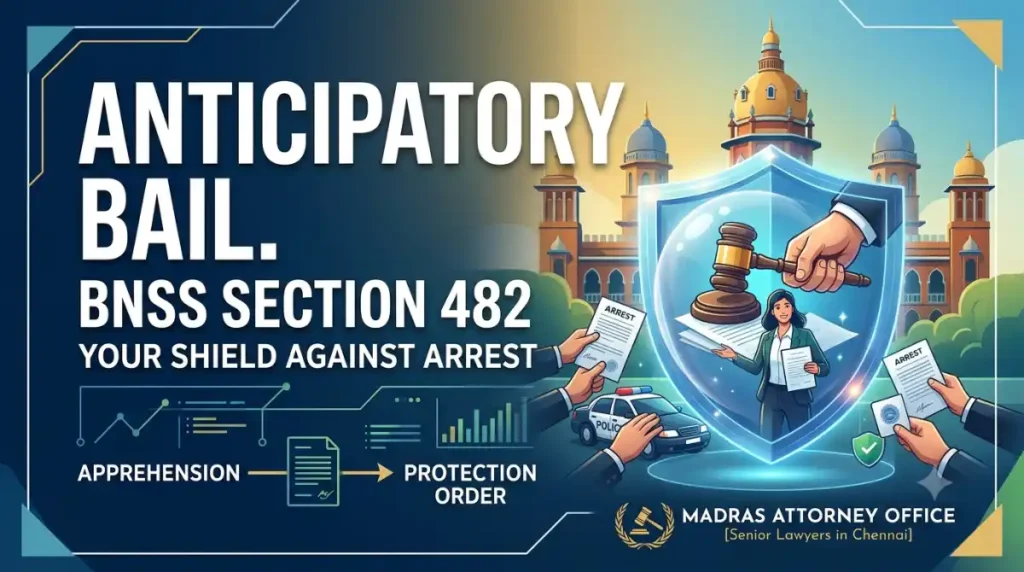
Navigating criminal procedure requires a precise understanding of personal liberty safeguards under Indian law. Below is the updated comprehensive guide on pre-arrest protection under the Bharatiya Nagarik Suraksha Sanhita, 2023 (BNSS), written for Madras Attorney Office [Senior Lawyers in Chennai].
Comprehensive Guide: Anticipatory Bail in India Under BNSS Section 482
A person who reasonably fears arrest for a non-bailable offence can seek pre-arrest relief in India. The newly enacted Bharatiya Nagarik Suraksha Sanhita, 2023 (BNSS) replaced the Code of Criminal Procedure, 1973 (CrPC). Consequently, Section 482 of BNSS now governs anticipatory bail petitions across the country.
Understanding these criminal statutory changes remains critical for protecting personal liberty. Accused individuals must demonstrate genuine apprehension grounded in concrete facts rather than vague allegations. Senior advocates examine police complaints, notices, and prior disputes before initiating court filings. Furthermore, early judicial intervention prevents unnecessary custodial detention during investigation processes.
This comprehensive article by Madras Attorney Office [Senior Lawyers in Chennai] details statutory frameworks, legal remedies, judicial forums, and procedural steps under current Indian laws.
| Legal Parameter | CrPC Provision (Old Law) | BNSS Provision (New Law) | Primary Judicial Forum |
| Anticipatory Bail | Section 438 CrPC | Section 482 BNSS | High Court / Sessions Court |
| Regular Bail | Section 437 / 439 CrPC | Section 480 / 483 BNSS | Magistrate / Sessions Court |
| Evidentiary Rules | Indian Evidence Act, 1872 | Bharatiya Sakshya Adhiniyam, 2023 | All Judicial Tribunals |
| Substantive Offences | Indian Penal Code, 1860 | Bharatiya Nyaya Sanhita, 2023 | Territorial Criminal Courts |
Legal Foundations of Pre-Arrest Bail Provisions
Defining Anticipatory Bail in the Indian Legal System
Anticipatory bail acts as a statutory shield against prospective custody for non-bailable offences. Under Section 482 BNSS, an applicant secures a direction for release if arrested by law enforcement agencies. Consequently, this extraordinary remedy prevents arbitrary detention and safeguards fundamental rights under Article 21 of the Constitution. Courts balance personal freedom against the necessity of fair state investigations.
Moreover, judicial discretion relies heavily upon establishing bona fide fears of police action. Applicants must highlight specific facts showing imminent threat to liberty. Additionally, senior criminal lawyers carefully draft petitions to highlight false accusations arising from personal animosity.
Apprehension of Arrest (Non-Bailable Offence)
                    │
                    ▼
Drafting Petition with Evidentiary Proof
                    │
                    ▼
Filing under Section 482 BNSS (Sessions Court or High Court)
                    │
                    ▼
Judicial Hearing & Interim/Final Protection Orders
Transition from CrPC Section 438 to BNSS Section 482
The transition from CrPC Section 438 to Section 482 BNSS retains core protective Principles. However, BNSS modernizes procedural steps while incorporating strict timeline mandates. Under BNSS Section 482, courts evaluate specific criteria including nature and gravity of charges, applicant precedents, and flight risk.
Furthermore, provisions require strict alignment with Bharatiya Nyaya Sanhita, 2023 (BNS) offences and Bharatiya Sakshya Adhiniyam, 2023 (BSA) evidentiary rules. Hence, legal practitioners must adapt strategies when presenting petitions before Chennai criminal courts.
Jurisprudential Scope and Essential Eligibility Criteria
Who Can Lawfully Apply for Pre-Arrest Judicial Relief?
Any citizen facing a reasonable apprehension of arrest in a non-bailable offence may apply. Specifically, the applicant need not be named directly in a formal First Information Report (FIR). Consequently, credible threats of custody from police communications or private complaints suffice for jurisdiction.
Furthermore, corporate executives, family members in matrimonial disputes, and business partners frequently seek early judicial protection. However, frivolous applications based on hypothetical fears face swift judicial dismissal. Senior advocates ensure that documented proof supports the claimed apprehension.
- Corporate Executives: Protection against white-collar crime allegations and financial disputes.
- Family Members: Relief in matrimonial disputes under BNS Section 85 and Section 86.
- Property Owners: Safeguards during civil land conflicts falsely converted into criminal cases.
- Professionals: Defense against professional negligence accusations in medical or legal sectors.
Demonstrating Reasonable Apprehension of Imminent Arrest
Establishing reasonable apprehension requires concrete material demonstrating prospective police action. For instance, receiving official police notices under BNSS Section 35(3) indicates active investigative attention. Similarly, frequent police visits to an applicant’s residence constitute valid grounds for seeking urgent relief.
Moreover, public statements by complainants or preliminary inquiry summons support the necessity of court intervention. Senior criminal lawyers analyze these elements carefully prior to moving petitions before appropriate judicial benches.
Competent Judicial Forums and Territorial Jurisdiction
Selecting Between Sessions Court and High Court
Section 482 of BNSS grants concurrent jurisdiction to the Court of Session and the High Court. Ordinarily, applicants must approach the Principal Sessions Court within their territorial limits first. However, exceptional circumstances allow direct petitions to the Madras High Court.
Furthermore, establishing prior local court filings prevents jurisdictional conflicts between concurrent forums. Senior attorneys determine forum selection based on urgency, complexity, and local procedural norms.
| Forum Level | Primary Jurisdiction | Typical Processing Time | Strategic Advantage |
| Sessions Court | Local Judicial District | 3 to 7 Days | Immediate local evidentiary evaluation |
| High Court | State-Wide / Appellate | 1 to 3 Days | Broad constitutional powers and immediate stay options |
| Supreme Court | Special Leave Petitions | Variable | Final constitutional remedy against adverse orders |
Navigating Territorial Jurisdiction in Chennai Courts
Territorial jurisdiction depends on where the alleged offence occurred or where the FIR is registered. In Chennai, petitions are routinely filed before the City Civil and Sessions Court or the Madras High Court. Additionally, local police stations like Egmore, Kilpauk, and Flower Bazaar fall under specific jurisdictional courts.
Moreover, cross-border offences require careful analysis of multi-jurisdictional police powers under BNSS. Senior advocates map police station limits precisely to prevent jurisdictional objections during initial hearings.
Judicial Discretion, Guiding Factors, and Court Conditions
Statutory Factors Influencing Judicial Decision-Making
Courts weigh multiple statutory factors before granting pre-arrest protection under BNSS Section 482. Chiefly, judges examine the gravity of alleged penal code violations under the Bharatiya Nyaya Sanhita. Furthermore, the applicant’s criminal antecedents and prior compliance record significantly influence judicial outcomes.
Additionally, courts evaluate whether the accusation aims to humiliate or harass the applicant. Therefore, presenting strong character references and clear documentary evidence enhances application success rates.
       Key Judicial Evaluation Factors
 ┌──────────────────────────────────────────┐
 │ 1. Gravity and nature of BNS charges     │
 │ 2. Criminal antecedents of applicant     │
 │ 3. Risk of absconding or fleeing justice │
 │ 4. Possibility of tampering with evidence│
 │ 5. Malafide intention of the complainant │
 └──────────────────────────────────────────┘
Standard Conditions Imposed by Criminal Courts
Granting anticipatory bail usually involves specific compliance conditions to protect investigations. For example, applicants must present themselves for police interrogation whenever required by investigative officers. Furthermore, courts strictly prohibit applicants from contacting witnesses or altering material evidence directly or indirectly.
Additionally, surrender of travel documents like passports prevents unauthorized international travel during ongoing trials. Failure to comply with these judicial directives leads directly to bail cancellation proceedings.
- Interrogation Compliance: Mandatory presence at police stations upon official written notice.
- Witness Protection: Absolute prohibition against contacting, threatening, or influencing witnesses.
- Travel Restrictions: Passport surrender and prior judicial permission before leaving India.
- Address Declaration: Informing investigating officers immediately regarding any change of residence.
Critical Statutory Exclusions and Exceptions under BNSS
Non-Applicability in Heinous Offences Under Section 482(4)
Section 482(4) of BNSS explicitly excludes pre-arrest relief for specified severe offenses. Specifically, offences under Section 65 and Section 70(2) of the Bharatiya Nyaya Sanhita, 2023 are non-dutiable under this provision. Consequently, individuals accused of aggravated sexual offenses or gang rape cannot seek anticipatory bail under Section 482.
Moreover, courts strictly enforce statutory bars to prioritize victim safety in grave offenses. Senior lawyers analyze charges carefully to determine statutory eligibility before petition preparation.
Special Enactments Overriding BNSS General Provisions
Special penal statutes maintain dedicated provisions that override standard BNSS anticipatory bail rules. For instance, the Scheduled Castes and Scheduled Groups (Prevention of Atrocities) Act limits pre-arrest relief. Similarly, economic laws like the Prevention of Money Laundering Act (PMLA) impose onerous twin bail conditions.
Furthermore, offences under the Narcotic Drugs and Psychotropic Substances (NDPS) Act require high evidentiary standards. Therefore, attorneys must navigate specialized statutory frameworks alongside BNSS procedural rules.
Interplay with Criminal Investigation and Police Powers
Maintaining Investigative Independence During Protection
Granting anticipatory bail does not stop or terminate an ongoing police investigation. The investigating officer retains full authority to collect evidence, interrogate suspects, and compile chargesheets. However, law enforcement agencies cannot physically detain the protected individual while orders remain active.
Furthermore, custodial interrogation requires investigators to seek specific judicial modification from the court. Hence, anticipatory protection maintains a balance between personal freedom and state police authority.
Custodial Interrogation Demands and Judicial Remedies
Investigating agencies often demand custodial interrogation to discover material facts under BSA Section 23. In such situations, police officers apply to the court for modification or cancellation of pre-arrest protection. Consequently, judges examine whether custodial questioning is truly necessary for effective investigation.
Moreover, senior defense attorneys present counter-arguments showing full cooperation by the applicant. Thus, courts protect individuals from coercive custodial tactics while ensuring fair evidentiary discovery.
Comprehensive Checklist: Preparing an Anticipatory Bail Application
Essential Documents and Evidentiary Requirements
Preparing a robust anticipatory bail application requires meticulous compilation of supporting records. First, applicants must attach copies of police complaints, FIRs, or statutory notices received under BNSS Section 35(3). Second, financial transactions, business contracts, or electronic messages must be organized according to BSA standards.
Third, proof of residential stability and social standing establishes low flight risk status. Finally, detailed affidavits sworn by the applicant support every factual assertion made within the petition.
- Identity & Address Proof: Aadhar card, passport, or utility bills establishing local residence.
- Police Notices: Official summons or notices issued under BNSS Section 35(3) or CrPC 41A.
- Dispute Proof: Contracts, emails, WhatsApp chats, or financial statements proving civil nature.
- Clean Record Affidavit: Documented declaration confirming no prior criminal convictions or pending cases.
Strategic Drafting Techniques for Senior Lawyers
Effective drafting focuses on establishing clean antecedents, lack of flight risk, and willingness to cooperate. The petition must clearly outline the civil or personal disputes motivating false criminal charges. Furthermore, attorneys must address each statutory condition laid out under BNSS Section 482 explicitly.
Additionally, incorporating relevant Supreme Court precedents strengthens the legal foundation of the application. Senior advocates ensure that every argument aligns perfectly with current procedural and substantive criminal law standards.
Special Legal Scenarios: Interim Protection and Cancellation
Securing Urgent Interim Relief and Interim Orders
When an application is filed, courts may grant immediate interim protection pending final arguments. Interim orders prevent police arrest during the period required for police report submissions. Consequently, this temporary relief allows applicants to organize their defense without fearing sudden detention.
Furthermore, interim orders remain subject to strict adherence to temporary conditions imposed by the bench. Senior criminal attorneys emphasize urgent interim hearings when police arrest appears imminent.
       Interim Protection Workflow
 ┌──────────────────────────────────────────┐
 │ 1. File Section 482 BNSS Petition        │
 │ 2. Present Urgent Ex-Parte Arguments     │
 │ 3. Obtain Interim Protection Order       │
 │ 4. Serve Order Copy to Police Station    │
 │ 5. Complete Final Hearing & Confirmation │
 └──────────────────────────────────────────┘
Grounds for Cancellation of Anticipatory Bail
Anticipatory bail is not an absolute right and remains subject to judicial cancellation. For example, breaching court-imposed conditions leads directly to cancellation proceedings under BNSS Section 483(3). Similarly, attempting to intimidate witnesses, destroy evidence, or evade police summons jeopardizes pre-arrest freedom.
Furthermore, investigating agencies can move the court if new un-bailable offences emerge during inquiry. Therefore, applicants must strictly obey all court directions to maintain ongoing pre-arrest protection.
Comprehensive Overview of Allied Criminal Laws and Tribunals
Interplay with CPC, BSA, and Specialized Forums
Criminal proceedings frequently intersect with civil law remedies governed by the Code of Civil Procedure (CPC). For instance, property or contractual disputes often trigger simultaneous civil suits and criminal complaints. Additionally, the Bharatiya Sakshya Adhiniyam, 2023 regulates the admissibility of digital and physical evidence during bail hearings.
Furthermore, specialized tribunals like NCLT, ED, and DRT handle complex commercial matters intersecting with penal law. Legal experts synthesize these varied statutory frameworks to deliver comprehensive defense strategies.
- Code of Civil Procedure (CPC): Manages parallel civil remedies, injunctions, and contractual disputes.
- Bharatiya Sakshya Adhiniyam (BSA): Governs electronic evidence certification and physical proof admissibility.
- Commercial Tribunals (NCLT/DRT): Handles insolvency and debt recovery disputes tied to criminal fraud allegations.
- Special Enforcement Forums: Manages financial crime investigations by specialized state and central agencies.
Specialized Legal Support Offered by Madras Attorney Office
Madras Attorney Office [Senior Lawyers in Chennai] provides comprehensive criminal defense solutions for complex legal matters. Our legal team handles pre-arrest petitions across all Chennai district courts and the Madras High Court. Furthermore, we specialize in corporate crime defense, white-collar allegations, and complex domestic disputes.
Additionally, our senior lawyers guide clients through police inquiries while preserving constitutional rights. We ensure rigorous petition drafting, strategic court representation, and absolute compliance with updated BNSS provisions.
Frequently Asked Questions (FAQs)
What is Section 482 of the Bharatiya Nagarik Suraksha Sanhita, 2023?
Section 482 BNSS provides pre-arrest bail mechanisms, replacing CrPC Section 438. It enables individuals apprehending arrest in non-bailable offences to seek judicial protection orders.
Can anticipatory bail be applied before an FIR is officially registered?
Yes, pre-arrest bail can be sought before formal FIR registration. Applicants must show genuine, reasonable apprehension of arrest based on credible notices, complaints, or police actions.
Which judicial forum handles anticipatory bail petitions in Chennai?
Applicants can approach the Principal Sessions Court or the Madras High Court. Forum choice depends on territorial jurisdiction, case complexity, and the urgency of prospective arrest threats.
Are there specific offences where anticipatory bail is statutorily barred?
Yes, BNSS Section 482(4) excludes offences under BNS Section 65 and Section 70(2). Additionally, special laws like SC/ST Act and PMLA contain specific restrictions regarding pre-arrest relief.
What happens if an applicant breaches anticipatory bail conditions?
Breaching court-imposed conditions allows police or prosecutors to apply for bail cancellation. Courts can revoke protection under BNSS Section 483(3), leading to immediate custodial arrest.
Does obtaining anticipatory bail stop police from conducting investigations?
No, pre-arrest bail does not stop police investigations. Protected individuals must fully cooperate with investigating officers, attend interrogations, and comply with all court mandates.