

Retainer Legal Service – Service matter disputes affect thousands of government and private employees across Chennai every year. Therefore, securing expert legal support through a retainer arrangement is absolutely essential today. Madras Attorney Office provides comprehensive retainer legal services for all service-related matters. Our experienced team actively handles disputes involving government servants, public sector employees, and private sector workers. Additionally, retainer services offer continuous legal protection rather than isolated, case-by-case interventions. Consequently, employees receive proactive advice before disputes escalate into full-scale litigation. The Central Administrative Tribunal (CAT), Tamil Nadu Administrative Tribunal (TNAT), and High Court of Madras are the primary forums for service matters. Furthermore, the Industrial Disputes Act, 1947 and Service Rules govern most employment-related legal issues. The Bharatiya Nyaya Sanhita, 2023 (BNS) addresses criminal dimensions of service-related misconduct cases. Our retainer clients receive priority legal attention, document review, and continuous strategic guidance throughout the year.
Understanding Retainer Legal Services for Service Matters in Chennai
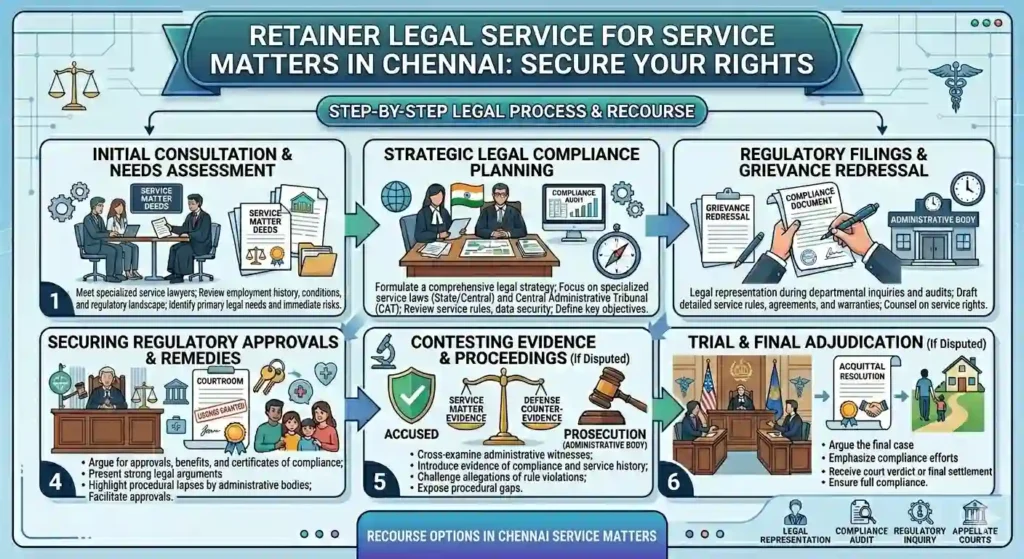
A retainer legal service is a pre-arranged, ongoing legal support agreement between a client and a law firm. Therefore, employees and organisations secure consistent legal assistance without engaging lawyers on a per-case basis. Retainer arrangements are particularly valuable in service matters involving complex employment laws and procedures. Additionally, government servants face unique challenges under various service rules and departmental regulations. The Tamil Nadu Government Servants (Conditions of Service) Act and Central Civil Services Rules govern most disputes. Furthermore, retainer services cover advisory, documentation, representation, and emergency legal assistance comprehensively. Our lawyers at Madras Attorney Office actively monitor regulatory updates affecting service law continuously. Consequently, retainer clients receive timely alerts about legal changes affecting their employment rights. The Bharatiya Nagarik Suraksha Sanhita, 2023 (BNSS) governs procedural aspects of service-related criminal investigations. Moreover, the Bharatiya Sakshya Adhiniyam, 2023 (BSA) regulates evidence admissibility in service matter proceedings before courts.
Key Benefits of Retainer Legal Services for Employees in Chennai
Retainer legal services provide structured, reliable legal protection for employees facing complex service disputes. Therefore, organisations and individuals choosing retainer arrangements gain significant strategic advantages over ad-hoc legal engagement. The following are the primary benefits of choosing a retainer legal service arrangement:
- Continuous Legal Monitoring – Lawyers proactively track regulatory and judicial changes affecting service law
- Priority Response – Retainer clients receive immediate legal assistance during emergencies and departmental proceedings
- Cost Efficiency – Fixed retainer fees reduce overall legal costs compared to per-case billing arrangements
- Preventive Legal Advice – Early legal guidance prevents minor disputes from escalating into costly litigation
- Document Review – All charge sheets, show-cause notices, and orders are reviewed by our expert legal team
- Court Representation – Retainer covers appearances before CAT, TNAT, High Court, and Labour Courts
- Confidential Legal Counsel – Secure and privileged legal advice on sensitive employment and service matters
- Multi-Forum Coverage – Single retainer provides legal support across all relevant tribunals and courts
Moreover, our retainer clients consistently report greater confidence in handling departmental proceedings effectively. Therefore, retainer legal services represent a smart investment in long-term employment security and legal protection.
Types of Service Matters Covered Under Retainer Legal Services
Service matters encompass a wide range of employment-related legal disputes requiring specialised legal expertise. Therefore, our retainer legal service comprehensively covers all categories of service-related legal issues. The following are the principal types of service matters handled under our retainer arrangement:
- Disciplinary Proceedings – Defence against departmental inquiries, charge sheets, and show-cause notices
- Suspension Matters – Challenging illegal or disproportionate suspension orders before appropriate tribunals
- Promotion Disputes – Legal action against arbitrary denial of promotion and supersession by junior officers
- Service Termination – Challenging illegal dismissal, removal, and compulsory retirement orders
- Pay and Allowance Disputes – Recovery of withheld salary, arrears, and allowances through legal proceedings
- Seniority Disputes – Correction of erroneous seniority lists through tribunal and court proceedings
- Transfer Disputes – Challenging punitive, arbitrary, or illegal transfer orders
- Pension and Retirement Benefits – Recovery of delayed or denied pension, gratuity, and provident fund
- Vigilance and Anti-Corruption Cases – Legal defence in DVAC, Lokayukta, and departmental investigations
- Whistleblower Protection – Legal protection for employees reporting corruption or malpractice
Furthermore, our retainer services extend to private sector employees facing wrongful termination and labour law violations. Consequently, both government and private sector employees benefit comprehensively from our retainer arrangements.
Applicable Laws Governing Service Matters in Chennai
Service matters in Chennai are governed by a comprehensive framework of central and state legislation. Therefore, understanding the applicable laws is critical for effective legal strategy and representation. The following table outlines the key laws governing service matters and their respective applicability:
| Law / Rule | Applicability | Key Provisions | Forum |
|---|---|---|---|
| Central Civil Services Rules, 1972 | Central Govt Employees | Discipline, Conduct, Appeals | CAT, High Court |
| TN Government Servants (Conditions of Service) Act | TN State Employees | Service Conditions, Penalties | TNAT, High Court |
| Industrial Disputes Act, 1947 | Private Sector Employees | Retrenchment, Closure, Strikes | Labour Court, Industrial Tribunal |
| Workmen’s Compensation Act, 1923 | Workmen | Compensation for Injury | Commissioner WC |
| Payment of Gratuity Act, 1972 | All Establishments | Gratuity Calculation, Recovery | Controlling Authority |
| BNS 2023 | Criminal Misconduct | Fraud, Cheating, Corruption | Sessions Court, Magistrate |
| Prevention of Corruption Act, 1988 | Public Servants | Bribery, Misappropriation | Special CBI Court |
| Whistleblowers Protection Act, 2014 | Public Employees | Disclosure Protection | Competent Authority |
Moreover, our retainer lawyers continuously update their knowledge of amendments and judicial interpretations. Therefore, clients receive the most current and accurate legal advice on all applicable service laws.
Disciplinary Proceedings: Legal Defence Under Retainer Service
Disciplinary proceedings represent the most frequent and serious challenge faced by government servants in Chennai. Therefore, having a retainer lawyer who understands departmental procedures provides a decisive strategic advantage. The disciplinary authority issues a charge sheet under Article 311 of the Constitution of India initially. Additionally, the employee must submit a written statement of defence within the stipulated time period. Our retainer lawyers actively draft detailed, legally sound replies to every charge sheet and show-cause notice. Furthermore, the Inquiry Officer conducts a departmental inquiry following prescribed natural justice principles mandatorily. The Bharatiya Nyaya Sanhita, 2023 (BNS) applies when charges involve criminal misconduct or fraudulent activities. Moreover, the High Court of Madras exercises supervisory jurisdiction over all disciplinary proceedings in Tamil Nadu. Retainer lawyers attend departmental inquiries as defence assistants, examining and cross-examining witnesses effectively. Consequently, employees represented by retainer counsel consistently achieve better outcomes in disciplinary proceedings. Our team also challenges legally defective charge sheets before appropriate courts and tribunals proactively.
Suspension Orders: Legal Challenges and Remedies Available
Suspension orders cause severe financial and professional hardship to government and private sector employees. Therefore, challenging illegal or disproportionate suspension orders requires immediate and expert legal intervention. The following remedies are available against illegal suspension orders in Chennai:
- Representation to Suspending Authority – Formal written representation challenging grounds of suspension
- Appeal to Appellate Authority – Statutory appeal before the designated appellate authority under service rules
- Original Application to CAT – Filing OA before the Central Administrative Tribunal for central employees
- Writ Petition to High Court – Article 226 petition before the Madras High Court for immediate relief
- Interim Stay – Application for stay of suspension pending final disposal of the case
- Subsistence Allowance Recovery – Legal action to recover withheld or reduced subsistence allowance
- Reinstatement Order – Court or tribunal order directing immediate reinstatement of the employee
Furthermore, our retainer team files emergency applications within 24 hours of receiving unlawful suspension orders. Consequently, clients receive swift legal protection that minimises the duration and impact of suspension.
Promotion Denial and Seniority Disputes: Legal Strategies
Arbitrary denial of promotion constitutes a serious violation of a government servant’s service rights. Therefore, employees must pursue legal remedies swiftly before the statute of limitations expires. The Supreme Court has held that promotion is a valuable civil right of every eligible government servant. Additionally, the Department of Personnel and Training (DoPT) guidelines govern promotion procedures for central employees. Seniority list errors frequently trigger cascading promotion disputes affecting multiple employees simultaneously. Furthermore, our retainer lawyers file Original Applications before the Central Administrative Tribunal, Chennai Bench, promptly. The Tamil Nadu Administrative Tribunal handles seniority and promotion disputes for state government employees. Moreover, erroneous Annual Confidential Reports (ACR) or Annual Performance Appraisal Reports (APAR) are challenged legally. Courts consistently quash promotion orders passed in violation of reservation and roster policies. Consequently, our retainer service ensures continuous monitoring of departmental promotion lists and seniority orders for clients.
Courts, Tribunals, and Forums for Service Matters in Chennai
Chennai hosts several specialised courts, tribunals, and forums that adjudicate service matter disputes efficiently. Therefore, identifying the correct forum for each dispute is the most critical step in legal strategy. The Central Administrative Tribunal (CAT), Chennai Bench handles disputes of central government employees exclusively. Additionally, the Tamil Nadu Administrative Tribunal (TNAT) resolves service disputes of Tamil Nadu state government employees. The High Court of Madras exercises writ jurisdiction over all service matters under Articles 226 and 227. Furthermore, Labour Courts in Chennai adjudicate disputes under the Industrial Disputes Act, 1947 efficiently. The Industrial Tribunal resolves disputes involving retrenchment, closures, and changes in service conditions. Moreover, the Employees’ State Insurance Court handles ESIC-related disputes for covered employees effectively. The Payment of Gratuity Controlling Authority adjudicates gratuity recovery disputes for all establishments. Consequently, our retainer lawyers regularly appear before all these forums on behalf of clients throughout Tamil Nadu.
Central Administrative Tribunal and High Court Proceedings
The Central Administrative Tribunal (CAT), Chennai Bench is the primary forum for central government service disputes. Therefore, central government employees must first approach CAT before filing writ petitions in the High Court. CAT was established under the Administrative Tribunals Act, 1985, to exclusively handle central service matters. Additionally, CAT has the power to grant interim relief including stay of impugned orders pending final disposal. The High Court of Madras supervises CAT proceedings and hears appeals against CAT orders under Article 226. Furthermore, writ petitions under Articles 226 and 227 directly challenge state government service orders before the High Court. The Division Bench of the Madras High Court hears Letters Patent Appeals against single-judge decisions. Moreover, the Supreme Court of India hears Special Leave Petitions against High Court judgments in service matters. Our retainer lawyers have extensive experience appearing before CAT, High Court, and the Supreme Court regularly. Consequently, clients receive seamless multi-forum representation through a single, integrated retainer legal service arrangement.
Labour Courts, Industrial Tribunals, and Employment Forums in Chennai
Private sector employees in Chennai primarily approach Labour Courts and Industrial Tribunals for service disputes. Therefore, understanding the jurisdiction of each forum helps employees choose the most appropriate legal remedy. The following are the key employment-related forums and their respective jurisdictions in Chennai:
- Labour Court, Chennai – Handles disputes under Industrial Disputes Act, 1947 for private sector workers
- Industrial Tribunal, Chennai – Adjudicates retrenchment, closure, and modification of service conditions
- Commissioner for Workmen’s Compensation – Decides compensation claims for work-related injuries and accidents
- Controlling Authority (Gratuity) – Resolves gratuity disputes under the Payment of Gratuity Act, 1972
- ESI Court, Chennai – Handles disputes under the Employees’ State Insurance Act, 1948
- PF Appellate Tribunal – Resolves Provident Fund disputes under the EPF and MP Act, 1952
- National Industrial Tribunal – Handles disputes of national importance referred by the Central Government
- DPDP Grievance Authority – Handles data privacy violations affecting employees under DPDP Act, 2023
Moreover, our retainer lawyers strategically select the most effective forum based on the specific nature of each dispute. Therefore, clients avoid jurisdictional errors that delay proceedings and dilute legal remedies significantly.
Police Stations and Investigation Authorities for Service-Related Offences
Service-related criminal offences require immediate complaint filing at appropriate police stations in Chennai. Therefore, identifying the correct investigative authority is the first essential step in criminal service matters. The following authorities handle service-related criminal complaints in and around Chennai:
- Jurisdictional Police Station – First point for FIR registration under BNSS Section 173 for service fraud cases
- Economic Offences Wing (EOW), Chennai – Investigates financial fraud involving public servants above ₹1 crore
- DVAC (Directorate of Vigilance and Anti-Corruption) – Handles bribery and corruption complaints against government servants
- CBI Special Unit – Investigates corruption involving senior central government officers in Chennai
- CB-CID Chennai – Handles complex organised criminal conspiracies in service-related matters
- Cyber Crime Police Station, Chennai – Handles online fraud, fake appointment orders, and digital service fraud
- Commissioner of Police’s Grievance Cell – Handles complaints against police personnel for service misconduct
- Lokayukta Office, Tamil Nadu – Receives corruption complaints against state public servants directly
Furthermore, our retainer criminal law team drafts detailed complaints and accompanies clients to police stations. Consequently, complaints are registered promptly and investigations proceed effectively under expert legal supervision.
Pension, Gratuity, and Retirement Benefit Disputes Under Retainer Service
Retirement benefit disputes cause significant financial hardship to retired government and private sector employees. Therefore, retainer legal service provides indispensable protection during and after the retirement process. The Central Civil Services (Pension) Rules, 2021 govern pension entitlements of central government retirees. Additionally, the Tamil Nadu Pension Rules govern pension rights of state government employees effectively. Gratuity disputes are resolved under the Payment of Gratuity Act, 1972 by the Controlling Authority. Furthermore, EPF disputes involving provident fund settlements are adjudicated by PF Appellate Tribunals efficiently. Our retainer lawyers file Original Applications before CAT for pension-related disputes of central employees. Moreover, writ petitions before the High Court of Madras provide effective relief for delayed pension orders. Departmental delay in settling retirement benefits constitutes a violation of fundamental rights under Article 21. Consequently, courts award interest on delayed pension payments as compensation for unconstitutional delay. Our retainer service covers continuous monitoring of retirement benefit processing for all retiring client-employees.
Wrongful Termination and Reinstatement: Legal Remedies Available
Wrongful termination devastates employees financially and professionally, demanding immediate expert legal intervention. Therefore, retainer legal services provide the fastest possible legal response to termination orders. The following legal remedies are available for wrongfully terminated employees in Chennai:
- Appeal to Appellate Authority – Statutory appeal within prescribed time under applicable service rules
- Original Application to CAT / TNAT – Challenge before appropriate administrative tribunal for government employees
- Labour Court Reference – Government reference for adjudication of industrial dispute under IDA, 1947
- Writ Petition under Article 226 – High Court petition for certiorari quashing illegal termination orders
- Reinstatement with Full Back Wages – Court or tribunal order directing reinstatement and recovery of salary
- Compensation in Lieu of Reinstatement – Monetary compensation where reinstatement is not practicable
- Contempt of Court Petition – Action against employer for non-compliance with reinstatement orders
Moreover, our retainer team files emergency applications for interim reinstatement within 48 hours of receiving termination orders. Consequently, clients minimise financial loss and professional disruption through swift, expert legal intervention.
Transfer Disputes and Punitive Transfers: Legal Recourse
Transfer orders, when punitive or arbitrary in nature, violate the service rights of government employees significantly. Therefore, legal challenges against such transfers must be filed swiftly before the appropriate forum. The Supreme Court has consistently held that transfers made with mala fide intent are legally unsustainable. Additionally, transfers that violate transfer policy guidelines are liable to be quashed by courts and tribunals. Our retainer lawyers immediately analyse transfer orders to identify legal infirmities and challenge validity effectively. Furthermore, representation before the Head of Department is filed simultaneously with legal proceedings as standard practice. Interim stay of transfer orders is regularly obtained from CAT and the High Court of Madras urgently. Moreover, employees transferred in violation of cadre-specific transfer policies receive immediate retainer legal support. Government servants protected under reservation policies receive special legal protection against arbitrary transfers. Consequently, our retainer service ensures rapid legal response to every transfer order received by client-employees.
Vigilance Cases, Anti-Corruption Investigations, and Legal Defence
Vigilance and anti-corruption investigations are among the most stressful experiences for government servants. Therefore, having a dedicated retainer lawyer during DVAC or CBI investigations provides crucial legal protection. The Prevention of Corruption Act, 1988 (as amended in 2018) governs corruption prosecutions of public servants. Additionally, the BNS 2023 applies to criminal misconduct, cheating, and breach of trust by public servants. DVAC conducts trap cases, document verification, and disproportionate assets investigations against Tamil Nadu officials. Furthermore, CBI handles corruption cases involving central government employees and inter-state matters effectively. The Special Court for CBI cases in Chennai adjudicates Prevention of Corruption Act offences exclusively. Moreover, accused public servants have the right to legal representation from the very first stage of investigation. Our retainer lawyers attend DVAC searches, accompany clients to police stations, and prepare legal defences proactively. Consequently, retainer clients avoid procedural pitfalls that often lead to unnecessary detention and adverse judicial observations.
Whistleblower Protection and Legal Support Under Retainer
Employees who report corruption or malpractice face serious professional retaliation from powerful department officials. Therefore, retainer legal services provide essential protective legal coverage for whistleblowers in Chennai. The Whistleblowers Protection Act, 2014 protects employees who disclose corruption or wilful misuse of power. Additionally, complaints are filed before the Competent Authority designated under the Act for protection. Our retainer lawyers actively assist whistleblowers in filing protected disclosures with appropriate authorities safely. Furthermore, retaliatory transfers, suspensions, or dismissals of whistleblowers are immediately challenged legally. The High Court of Madras consistently protects genuine whistleblowers against retaliatory administrative actions. Moreover, criminal complaints under BNS 2023 are filed against officials who victimise whistleblower employees. Our team coordinates with the Central Vigilance Commission (CVC) for central government whistleblower matters. Consequently, retainer clients who expose corruption receive comprehensive legal protection throughout the disclosure and investigation process.
Government Departments Involved in Service Matters in Chennai
Multiple government departments play critical roles in service matter disputes across Chennai and Tamil Nadu. Therefore, understanding each department’s function helps clients navigate the administrative and legal landscape effectively. The following are the principal government departments involved in service matter disputes:
- Department of Personnel and Training (DoPT) – Issues service rules, circulars, and guidelines for central employees
- Tamil Nadu Public Service Commission (TNPSC) – Oversees recruitment and service conditions for state employees
- Accountant General, Tamil Nadu – Processes pension, provident fund, and retirement benefit payments
- Finance Department, Government of Tamil Nadu – Governs pay revisions, allowances, and service condition policies
- Personnel and Administrative Reforms Department – Issues transfer, promotion, and disciplinary orders for TN employees
- Directorate of Vigilance and Anti-Corruption (DVAC) – Investigates corruption and misconduct allegations against officials
- Central Vigilance Commission (CVC) – Supervises vigilance activities for central government organisations
- EPFO Regional Office, Chennai – Manages provident fund disputes for private sector employees
Moreover, our retainer team regularly liaises with these departments to expedite administrative decisions for clients. Therefore, clients resolve departmental bottlenecks far more efficiently with professional retainer legal assistance.
Legal Remedies Available in Service Matter Disputes: A Complete Guide
Service matter disputes offer multiple legal remedies depending on the nature and severity of the violation. Therefore, selecting the right combination of remedies maximises the client’s chances of a favourable outcome. The following comprehensive list outlines all available remedies in service matter disputes:
- Statutory Appeal – First-level appeal before the designated appellate authority under applicable service rules
- Revision Petition – Application to a higher authority for revision of an order on merits
- Original Application (OA) – Filing before CAT or TNAT challenging service-related orders directly
- Writ Petition (Article 226) – High Court petition for certiorari, mandamus, or prohibition orders
- Special Leave Petition (SLP) – Supreme Court appeal against High Court orders in service matters
- Contempt of Court – Action against officials who disobey court or tribunal orders wilfully
- Criminal Complaint (BNS 2023) – FIR for service fraud, cheating, and criminal breach of trust
- Consumer Forum Complaint – For service-related disputes involving private educational institutions
- Arbitration – Alternative dispute resolution where service contract contains arbitration clause
- Compensation Claim – Monetary claim for losses caused by illegal service orders
Furthermore, our retainer lawyers recommend the most efficient remedy pathway after evaluating each client’s unique circumstances. Consequently, clients avoid wasted time and resources by pursuing legally sound and strategically optimal remedies.
Why Choose Madras Attorney Office for Retainer Legal Services
Madras Attorney Office is one of Chennai’s most experienced law firms specialising in service matter litigation. Therefore, our retainer legal services provide unmatched expertise, responsiveness, and strategic depth to every client. Our senior lawyers have appeared before the CAT Chennai Bench, TNAT, and Madras High Court extensively. Additionally, we maintain a dedicated service law division staffed by specialists in government and employment law. Our retainer clients receive personalised attention from senior partners rather than junior associates exclusively. Furthermore, we offer flexible retainer packages designed to meet the needs of individuals, associations, and organisations. Our legal team proactively identifies potential service law risks before they develop into formal disputes. Moreover, our lawyers provide 24-hour emergency advisory services for urgent suspension and termination situations. We additionally represent government employee associations, unions, and cooperative societies on retainer arrangements comprehensively. Consequently, Madras Attorney Office is the most trusted choice for retainer legal services across Chennai and Tamil Nadu.
Frequently Asked Questions (FAQs) – Retainer Legal Service for Service Matters
1. What is a retainer legal service for service matters?
A retainer legal service is a pre-paid, ongoing legal support arrangement. It covers advisory, documentation, and court representation for all service matter disputes throughout the retainer period, providing continuous protection.
2. Which tribunal handles central government service disputes in Chennai?
The Central Administrative Tribunal (CAT), Chennai Bench, exclusively handles central government service disputes. State employees approach the Tamil Nadu Administrative Tribunal (TNAT) for service matter redressal and relief.
3. Can a retainer lawyer attend departmental inquiries on my behalf?
Yes. Retainer lawyers can appear as Defence Assistants in departmental inquiries. They cross-examine witnesses and present legal arguments. They also draft replies to charge sheets and show-cause notices on behalf of the employee.
4. What laws protect government employees from wrongful suspension?
Article 311 of the Constitution, Central Civil Services Rules, and Tamil Nadu Service Rules protect employees from wrongful suspension. Courts and CAT can stay illegal suspension orders and direct reinstatement with full subsistence allowance payment.
5. Can private sector employees also benefit from retainer legal services?
Yes. Private sector employees facing wrongful termination, retrenchment, or labour law violations benefit significantly. Our retainer services cover Labour Courts, Industrial Tribunals, and ESI Courts for private sector service matter disputes.
6. What is the role of DVAC in service matter disputes?
DVAC investigates corruption and misconduct allegations against Tamil Nadu government servants. Our retainer lawyers provide legal defence, accompany clients during DVAC inquiries, and challenge disproportionate assets cases before appropriate courts.
7. How quickly can a retainer lawyer respond to an emergency suspension order?
Madras Attorney Office retainer lawyers respond within 24 hours to emergency suspension orders. We immediately file interim stay applications before CAT or the High Court of Madras to protect the client’s rights.
8. Which court handles corruption cases against public servants in Chennai?
The Special CBI Court in Chennai handles Prevention of Corruption Act cases. Sessions Courts adjudicate BNS 2023 offences involving public servants. DVAC files charge sheets in designated courts for Tamil Nadu government servant corruption cases.
9. Can delayed pension payments be recovered through legal action?
Yes. Courts and CAT direct payment of delayed pension with interest as compensation. Writ petitions under Article 226 compel departments to settle retirement benefits promptly. Courts treat pension delay as a violation of fundamental rights under Article 21.
10. How does Madras Attorney Office structure its retainer legal service packages?
We offer flexible individual, association, and organisation retainer packages. All packages include advisory, document review, forum appearances, and emergency legal support. Contact Madras Attorney Office to customise a retainer plan for your specific service matter needs.
Read More
- Expert Litigation Services for Service Matters in Chennai: Trust Our Attorneys
- Find Legal Support Nearby for Service Matters in Chennai: Contact Us Now
- 24/7 Legal Helpline for Service Matters in Chennai: Expert Support Guaranteed
- Seeking Legal Help for Service Matters in Chennai? Contact Our Attorneys
- Expert Legal Guidance for Service Matters in Chennai: Your Trusted Advisors
- Ministry of Labour and Employment (Government of India)