
An accident can create medical expenses, lost income, emotional distress, and serious family hardship. Therefore, timely legal assistance can protect your right to seek appropriate compensation. Accident claims attorneys in Chennai help injured persons and families understand claims, evidence, insurance issues, and tribunal procedures. Moreover, they can coordinate legal action after road accidents, vehicle collisions, pedestrian injuries, and fatal accidents. The Motor Vehicles Act, 1988 provides the principal framework for motor accident compensation claims. Section 166 allows eligible claimants to approach the Motor Accidents Claims Tribunal, subject to statutory requirements. The Claims Tribunal can conduct an inquiry and determine compensation considered just under Section 168. Additionally, the Bharatiya Sakshya Adhiniyam, 2023 recognizes electronic and digital records subject to statutory requirements. Therefore, prompt legal support can help preserve evidence and pursue available remedies.
Understanding Accident Compensation Claims in Chennai
Legal Foundations for Motor Accident Compensation
Motor Vehicles Act and Compensation Rights
Section 166 Motor Accident Claims
The Motor Vehicles Act accident claim process generally focuses on establishing the accident, injury, death, and resulting losses. Section 166 permits compensation applications before the appropriate Claims Tribunal. The statute provides jurisdictional choices based on the accident location, claimant residence, business location, or defendant residence. Consequently, a Chennai accident may involve a tribunal with jurisdiction determined by the statutory framework and facts. Accident claims attorneys in Chennai examine the police record, medical documents, insurance details, and employment evidence. They also identify the correct respondents, including vehicle owners, drivers, and insurers. Furthermore, lawyers calculate medical expenses, income loss, disability-related losses, and other legally supportable damages. The Claims Tribunal can determine compensation and identify responsible payers after hearing relevant parties. Therefore, professional representation can reduce procedural mistakes and improve evidence organization. Claimants should preserve every relevant document from the earliest stage after an accident.
Section 168 Tribunal Compensation
Section 168 empowers the Claims Tribunal to conduct an inquiry after receiving a compensation application. The Tribunal considers the parties’ submissions before determining the compensation payable under the applicable law. Accordingly, an MACT compensation claim in Chennai requires careful presentation of liability and financial losses. Lawyers prepare evidence showing how the accident occurred and how injuries affected the claimant. They may also address disputed insurance coverage, vehicle ownership, driving conduct, and contributory negligence allegations. Moreover, medical evidence can establish treatment duration, disability, future care requirements, and functional limitations. Income evidence may include salary records, tax documents, bank statements, employment letters, or business records. The Tribunal has powers comparable to a Civil Court for specific evidentiary and procedural purposes. Therefore, accident claims attorneys can organize documentary and witness evidence systematically. This approach supports a clear compensation assessment based on established facts.
Types of Accident Claims and Injuries
Motor Vehicle Injury Claims
Motor vehicle accidents can involve cars, motorcycles, buses, trucks, commercial vehicles, and other transport vehicles. Therefore, road accident compensation lawyers in Chennai handle claims involving different vehicle categories and injury circumstances. Common cases include rear-end collisions, intersection crashes, pedestrian accidents, and motorcycle collisions. Claims can also arise from negligent driving, unsafe manoeuvres, speeding, or other legally relevant conduct. Additionally, victims may face fractures, spinal injuries, head trauma, internal injuries, or permanent disabilities. Serious injuries can affect employment, education, family responsibilities, and future earning capacity. Consequently, compensation assessment should consider both immediate expenses and longer-term consequences. Lawyers review medical reports, diagnostic records, discharge summaries, prescriptions, and rehabilitation documents. They also examine accident information recorded by police authorities and available vehicle records. A structured claim can connect the accident directly with the documented financial and personal consequences. Therefore, early legal review can help identify overlooked compensation components.
Fatal Accident and Family Claims
A fatal road accident creates different legal concerns because surviving family members may pursue compensation. Fatal accident claim lawyers in Chennai assist legal representatives in understanding available statutory remedies. The claim may require proof concerning the deceased person’s identity, occupation, income, dependants, and relationship with claimants. Furthermore, death certificates, post-mortem records, police documents, medical records, and financial evidence can become important. Lawyers also examine insurance policies and the legal status of the offending vehicle. Compensation calculations can involve dependency losses and other legally recognized heads of damages. The exact assessment depends upon applicable law, evidence, and judicial principles. Additionally, family members may need assistance when insurers dispute liability or quantum. The Motor Vehicles Act contains specific provisions governing compensation proceedings and Tribunal awards. Therefore, families should obtain legal guidance before accepting settlements or abandoning statutory remedies. Proper representation can also help coordinate multiple legal and administrative requirements.
Evidence Required for Accident Compensation
Building a Strong Accident Evidence File
Police Complaints and Accident Records
A police complaint can become an important part of an accident claim evidence file. Therefore, accident victims should promptly report serious incidents to the appropriate police authority. Chennai has dedicated traffic investigation arrangements, with the official Chennai Police material recording multiple traffic police stations. Police records may contain information concerning the accident location, vehicles, witnesses, and alleged driving conduct. Additionally, investigation materials can support the factual narrative presented before the Claims Tribunal. Claimants should preserve the complaint, FIR where registered, accident records, vehicle details, and other available documents. Lawyers can review inconsistencies between police records, medical records, and insurance statements. Furthermore, prompt evidence preservation matters because CCTV footage and witness recollections may become unavailable. Chennai’s official district administration lists police and traffic emergency contacts, including police and traffic police numbers. Therefore, accident victims should prioritize emergency medical care and lawful reporting after an accident.
Medical and Financial Evidence
Medical evidence directly supports the relationship between an accident and resulting treatment requirements. Therefore, claimants should preserve hospital records, diagnostic reports, prescriptions, bills, discharge summaries, and rehabilitation documents. Financial evidence can establish expenses and income-related losses arising from the accident. Useful records may include salary slips, bank statements, employment certificates, tax filings, invoices, and business documents. Moreover, permanent disability claims require careful medical and functional evidence. Doctors may document impairment, treatment requirements, restrictions, and expected recovery limitations. Lawyers can use these records when presenting compensation calculations before the Claims Tribunal. The Bharatiya Sakshya Adhiniyam, 2023 also recognizes electronic and digital records within its evidentiary framework. Consequently, relevant emails, messages, photographs, digital documents, and other records may require proper preservation. Evidence should remain authentic, complete, and traceable. Therefore, accident victims should avoid deleting original digital material after an accident.
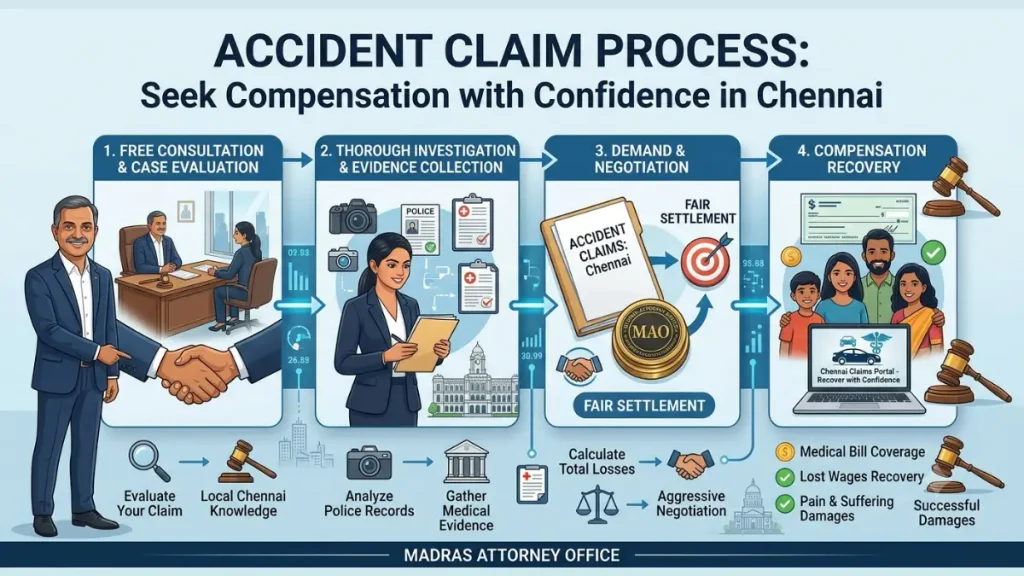
Accident Claim Procedure, Forums and Remedies
Filing and Conducting an MACT Claim
Jurisdiction, Petition and Tribunal Proceedings
Choosing the Appropriate Claims Tribunal
Choosing the correct forum represents an important part of MACT legal services in Chennai. Section 166 identifies several jurisdictional possibilities for compensation applications. These include the Tribunal connected with the accident location and specified jurisdictions connected with claimants or defendants. Therefore, lawyers first examine where the accident occurred and where relevant parties reside or conduct business. Chennai cases can involve different territorial areas across the city’s administrative and police jurisdictions. The official Chennai District administration identifies areas including Guindy, Mylapore, Velachery, Egmore, Mambalam, Anna Nagar, and others. However, administrative boundaries do not automatically determine Tribunal jurisdiction. Legal counsel must apply the statutory provisions and applicable Tribunal rules. Furthermore, lawyers verify the correct respondents before filing the petition. Proper jurisdiction and party identification can prevent avoidable procedural objections.
Accident Claim Petition Preparation
An accident compensation petition should present the accident facts, injuries, losses, respondents, and supporting evidence clearly. Lawyers generally organize the petition around liability, causation, damages, and documentary support. First, the petition identifies the claimant and explains the relationship with the injured or deceased person. Next, it describes the accident circumstances and vehicles involved. Then, it explains treatment, disability, income loss, and other claimed losses. Supporting documents should correspond with the factual allegations whenever available. Furthermore, insurance policy information can help identify the relevant insurer. Lawyers may also prepare affidavits, witness evidence, medical documents, and financial records. The Claims Tribunal has powers to take evidence and compel attendance or production for specified purposes. Therefore, legal preparation should anticipate likely objections from vehicle owners and insurers. A well-organized petition allows the Tribunal to understand the claim efficiently.
Insurance Company and Liability Disputes
Third Party Insurance Claims
Third-party motor insurance disputes can create significant challenges after serious accidents. Therefore, third party accident claim lawyers in Chennai examine policy documents and statutory insurance obligations. The claimant’s legal strategy depends on the accident facts, vehicle status, policy terms, and applicable statutory provisions. Insurers may dispute liability using policy-related or factual grounds. Consequently, claimants should not assume that an insurer’s first response conclusively determines compensation entitlement. Lawyers can examine policy documents, vehicle records, driving information, and Tribunal evidence. They may also address disputes involving ownership, driver identity, licence issues, or alleged policy breaches. Furthermore, the Tribunal determines responsibility after considering evidence and applicable law. Section 168 specifically allows the Tribunal to identify amounts payable by the insurer, owner, driver, or applicable combination. Therefore, careful representation can address insurer objections systematically. Claimants should retain every communication exchanged with insurers during settlement discussions.
Contributory Negligence and Liability
Contributory negligence in accident claims can affect compensation when evidence indicates conduct by the claimant contributed to the accident. Therefore, lawyers must examine traffic conditions, vehicle movements, witness statements, photographs, CCTV evidence, and police materials. An insurer may raise allegations concerning speed, road positioning, protective equipment, or other circumstances. However, each allegation requires consideration against the available evidence and applicable legal principles. Accident claims attorneys can challenge unsupported allegations through documentary and witness evidence. They can also distinguish between actual causation and speculative assertions. Moreover, photographs showing road conditions or vehicle damage may clarify disputed circumstances. Digital evidence can also become relevant under the Bharatiya Sakshya Adhiniyam, 2023, subject to statutory admissibility requirements. Consequently, evidence preservation should begin immediately after the accident. A detailed factual reconstruction can help the Tribunal assess competing versions fairly.
Legal Framework, Government Authorities and Remedies
Current Laws Governing Accident Disputes
Motor Vehicles Act and MACT Law
The Motor Vehicles Act, 1988 remains the central statutory framework for motor accident compensation claims. Sections concerning claims, Tribunal awards, and Tribunal procedure are particularly relevant to compensation proceedings. Therefore, Motor Vehicles Act lawyers in Chennai should assess each case using the current statutory framework and applicable rules. The Claims Tribunal follows a summary procedure suitable for accident compensation inquiries. Additionally, the statute addresses jurisdiction and the relationship between different compensation remedies. Legal advice should account for amendments and currently applicable procedural requirements. Claimants should therefore avoid relying solely on outdated articles or informal online advice. Furthermore, accident cases may involve connected criminal investigation and evidence issues. Those issues can involve the Bharatiya Nyaya Sanhita, Bharatiya Nagarik Suraksha Sanhita, and Bharatiya Sakshya Adhiniyam. India Code identifies these three 2023 enactments as current central legislation. Accordingly, legal counsel should separate compensation proceedings from connected criminal processes.
BNS, BNSS and BSA in Accident Cases
The Bharatiya Nyaya Sanhita, 2023 contains provisions concerning offences affecting human life, including causing death by negligence. Section 106 addresses causing death by negligence. Consequently, certain fatal accidents can involve both criminal investigation and compensation proceedings. The Bharatiya Nagarik Suraksha Sanhita, 2023 governs criminal procedure after applicable offences are reported. Meanwhile, the Bharatiya Sakshya Adhiniyam, 2023 governs evidence in judicial proceedings and recognizes electronic records within its statutory framework. Therefore, lawyers may need to coordinate police investigation materials with Tribunal evidence. However, a criminal case and compensation claim serve different legal purposes. A criminal investigation concerns alleged offences and criminal responsibility. A compensation claim concerns monetary relief arising from the accident. Furthermore, evidence should be preserved consistently across both proceedings. Professional legal coordination can prevent conflicting statements and unnecessary procedural complications.
Courts, Police Stations and Government Departments
Chennai Police and Traffic Investigation
The Chennai Police and its traffic investigation units can become important after road accidents. Official Chennai Police information records a dedicated traffic structure with traffic investigation police stations. Therefore, victims should identify the police station responsible for the accident location. Depending on the location, relevant areas can include Guindy, Adyar, T. Nagar, Mylapore, Anna Nagar, Egmore, Velachery, and other Chennai divisions. Chennai District records also identify administrative areas across these localities. Accident victims should not assume that a particular police station has jurisdiction without verification. Instead, they should report promptly and retain complaint details. Chennai’s official helpline page lists police, traffic police, and accident emergency contacts. Lawyers can assist when victims face difficulties obtaining records or communicating with insurers. Consequently, coordinated police and legal follow-up can protect important evidence.
RTO, Insurer and Other Authorities
The Regional Transport Office can hold records relevant to vehicle registration, ownership, and licensing matters. Chennai District officially lists several RTO offices, including Chennai North, Central, East, West, South, and other regional offices. Therefore, accident claims attorneys may seek relevant vehicle information when disputes arise. The insurance company also plays a central role in third-party compensation proceedings. Additionally, hospitals provide medical records supporting treatment and disability claims. Police authorities provide investigation records and accident-related materials. The Claims Tribunal evaluates the evidence and determines compensation under the applicable statutory framework. Depending on the dispute, appellate courts may also become relevant. Furthermore, connected civil proceedings may involve the Civil Procedure Code, 1908, where legally applicable. However, MACT proceedings have their own statutory procedure under the Motor Vehicles Act. Therefore, lawyers should identify the correct forum before commencing litigation.
Civil Courts, High Courts and Appeals
The Motor Accident Claims Tribunal is the principal forum for statutory motor accident compensation claims. Section 169 grants the Tribunal specific powers for evidence, witnesses, documents, and related inquiry functions. Therefore, claimants should generally approach the designated Claims Tribunal rather than treating every accident dispute as an ordinary civil suit. The Civil Procedure Code may become relevant in connected proceedings where applicable, but the Motor Vehicles Act remains central. Appeals and supervisory remedies can involve higher judicial forums depending on the order, statutory provision, and procedural posture. Lawyers assess whether an appeal, review, revision, writ proceeding, or other remedy is legally available. Furthermore, limitation requirements must be checked against the current statute and applicable rules. Claimants should avoid delaying legal advice because evidence and procedural opportunities can change over time. Therefore, accident compensation lawyers in Chennai can identify the appropriate forum and remedy. The correct legal route depends on the facts and the challenged decision.
Compensation Strategy and Professional Legal Support
Calculating Compensation and Pursuing Remedies
Heads of Compensation in Accident Claims
Medical Expenses and Treatment Costs
Medical expenses often form a significant component of accident compensation claims. Therefore, claimants should maintain complete records of hospital charges, medicines, diagnostics, surgeries, consultations, and rehabilitation. Expenses may arise during emergency treatment and subsequent follow-up care. Consequently, lawyers review bills alongside medical reports to establish their connection with the accident. Future medical needs can also become relevant where evidence supports continuing treatment or rehabilitation. Additionally, serious injuries may require physiotherapy, assistive devices, home care, or specialised medical supervision. Each claimed expense should have credible documentary support wherever possible. Accident claims attorneys can organize medical records chronologically to explain the treatment journey. Furthermore, medical opinions may help establish permanent disability and functional consequences. The Claims Tribunal evaluates evidence before determining the compensation considered legally appropriate. Therefore, claimants should avoid discarding even seemingly minor medical records. Complete documentation can provide a clearer basis for assessing treatment-related losses.
Income Loss and Future Earning Capacity
Accidents can prevent injured persons from working temporarily or permanently. Therefore, loss of income compensation requires evidence concerning occupation, earnings, absence, and functional limitations. Employees may provide salary slips, employer certificates, attendance records, and bank statements. Self-employed persons may use tax records, invoices, account statements, contracts, and business records. Furthermore, permanent disability can affect future earning capacity differently from temporary absence. Lawyers examine medical evidence and the claimant’s actual occupation when presenting these issues. They may also distinguish physical impairment from its effect on employment functions. Consequently, compensation analysis should not rely on medical percentage alone. The evidence must explain how the injury affects practical work responsibilities. Additionally, age, qualifications, occupation, and career prospects may become relevant according to applicable legal principles. Proper documentation helps connect disability with economic consequences. Therefore, accident claims attorneys can build a structured calculation supported by medical and financial records.
Settlement, Recovery and Enforcement
Negotiated Settlement and Insurance Resolution
Settlement discussions can sometimes resolve accident compensation disputes without prolonged litigation. Therefore, lawyers may communicate with insurers and opposing parties after reviewing liability and evidence. A settlement should reflect the claimant’s legally supportable losses and future requirements. Claimants should understand the consequences before signing any full-and-final settlement document. Furthermore, lawyers examine whether proposed terms adequately address medical expenses, income loss, disability, and family dependency. They also verify payment schedules, releases, and other settlement conditions. However, settlement suitability depends entirely on individual facts and applicable law. Accident claims attorneys should explain the legal consequences before recommending acceptance of any proposal. If negotiations fail, the claimant may continue pursuing available statutory remedies. The Tribunal can determine compensation after conducting the required inquiry. Therefore, negotiation and litigation should remain connected to a clear evidence strategy. Proper legal review can reduce the risk of premature or poorly documented settlements.
Tribunal Award and Compensation Recovery
After considering the claim and evidence, the Claims Tribunal may determine compensation under Section 168. The award identifies the compensation amount and the persons responsible for payment under applicable circumstances. Therefore, obtaining an award is only one stage of effective accident claim representation. Lawyers may need to monitor compliance with the award and address delays in payment. The Motor Vehicles Act specifies a statutory framework concerning deposit of awarded amounts. Claimants should preserve certified copies of orders and relevant payment records. Furthermore, any challenge to an award requires prompt legal assessment of the available appellate remedy. Lawyers can examine whether the insurer, owner, driver, or claimant seeks further judicial relief. Consequently, post-award legal support can remain important until the compensation process concludes. Enforcement steps depend on the nature of the order and applicable procedure. Therefore, claimants should obtain legal advice immediately after receiving an award or adverse order.
Choosing Accident Claims Attorneys in Chennai
Practical Legal Support for Accident Victims
24×7 Accident Legal Assistance
Accidents can occur at any hour, and early legal guidance can protect important evidence. Therefore, 24×7 accident lawyers in Chennai can assist victims with immediate procedural concerns. Initial support may include police reporting guidance, evidence preservation, insurer communication, hospital documentation, and family coordination. Lawyers can also identify urgent issues involving vehicle seizure, medical evidence, CCTV footage, or witness details. Furthermore, they can explain the distinction between criminal proceedings and compensation claims. This distinction helps families avoid confusion during stressful circumstances. Accident claims attorneys can later prepare the MACT petition and supporting evidence. They can also coordinate with insurers and other respondents during the claim process. Consequently, professional representation can provide continuity from accident reporting through Tribunal proceedings. However, emergency medical treatment should always receive immediate priority. Chennai District lists accident emergency assistance through 108 and police assistance through 100. Legal services should complement, not delay, emergency medical and safety measures.
Evidence Review and Claim Strategy
A strong accident claim begins with a complete factual and documentary assessment. Therefore, lawyers should review the accident location, police records, medical evidence, vehicle documents, insurance records, and financial losses. They can identify missing documents and recommend practical steps for obtaining them. Furthermore, they can examine photographs, CCTV footage, dashcam material, mobile records, and other relevant digital evidence. The Bharatiya Sakshya Adhiniyam expressly recognizes electronic and digital records within its evidentiary framework. Lawyers can therefore assess how digital evidence should be preserved and presented. They may also identify inconsistencies between insurer statements and accident records. Additionally, they can prepare witnesses for lawful testimony without influencing their evidence. A clear claim strategy should address liability, damages, jurisdiction, respondents, and procedural requirements. Consequently, early evidence review can reduce avoidable disputes. Professional legal analysis helps ensure that important compensation issues receive appropriate attention.
Client-Focused Representation and Remedies
Accident compensation legal support should address both immediate concerns and long-term procedural needs. Therefore, a law firm can assist with claim assessment, document collection, petition drafting, evidence preparation, hearings, negotiation, and appeals. Available remedies may include statutory compensation claims, insurer negotiations, Tribunal proceedings, appellate challenges, and enforcement steps. The correct remedy depends on the accident facts, injury severity, evidence, and applicable law. Furthermore, lawyers can coordinate with police authorities, RTO offices, insurers, hospitals, and other relevant departments. They can also help families understand procedural developments without unnecessary legal jargon. The Claims Tribunal’s statutory powers make evidence management especially important during proceedings. Therefore, representation should combine legal research with careful factual preparation. Madras Attorney Office can position its accident claims practice around accessible guidance and structured case management. Clients should receive clear explanations of risks, procedures, evidence requirements, and possible legal outcomes. This approach helps accident victims pursue lawful compensation with greater procedural confidence.
Frequently Asked Questions About Accident Claims Attorneys in Chennai
What does an accident claims attorney do?
An accident claims attorney reviews evidence, identifies responsible parties, prepares compensation claims, handles insurers, represents clients before MACT, and assists with appeals or recovery.
Where can I file a motor accident compensation claim?
Section 166 permits filing before a Claims Tribunal having jurisdiction under the Motor Vehicles Act. The appropriate forum depends on accident and party-related jurisdictional facts.
Can I claim compensation after a fatal road accident?
Yes, eligible legal representatives may pursue statutory compensation for a deceased person’s accident claim. Evidence concerning dependency, income, death, and accident circumstances remains important.
What evidence should I preserve after an accident?
Preserve police records, medical documents, photographs, bills, insurance papers, vehicle details, witness information, CCTV footage, and relevant electronic records.
Does a criminal accident case replace a compensation claim?
No. Criminal proceedings address alleged offences, while MACT proceedings address compensation. A single accident can therefore create separate legal proceedings.
Why hire accident claims attorneys in Chennai?
Lawyers can manage evidence, jurisdiction, MACT petitions, insurance disputes, hearings, settlements, appeals, and enforcement while coordinating relevant authorities and legal remedies.
Read More
Retainer Legal Service for Service Matters in Chennai: Secure Your Rights